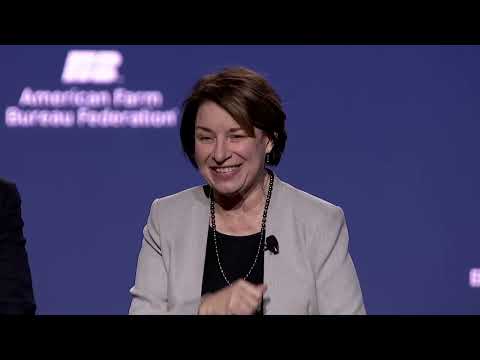

ANAHEIM — In a rare joint appearance, all four leaders of the congressional agriculture committees convened during a general session at American Farm Bureau Federation’s annual meeting to give their respective views to an audience of 4,500 farmers on the odds of passing a new farm bill.
The chair of the U.S. Senate Committee on Agriculture, Nutrition, and Forestry, Sen. John Boozman (R-Arkansas), and Ranking Member Sen. Amy Klobuchar (D-Minnesota) as well as the chair of the U.S. House Committee on Agriculture, Rep. Glenn “GT” Thompson (R-Pennslyvania), and Ranking Member Rep. Angie Craig (D-Minnesota) all agreed that securing a new five-year farm bill — already twice delayed and extended — is a priority.
According to Boozman, while the $68 billion One Big Beautiful Act (OBBA) passed last July has already addressed a majority of the farm bill budget needs, Congress still needs to approve the full package.
“Now we need to come back and finish that up,” said Boozman, adding that what remains are relatively minor budget requirements. But several of those items, including nutrition programs, are “poison pill” issues that are stalling passage.
Calling the current farm economy the “perfect storm of ugly,” Klobuchar said reversing tariffs could be a good first step to resorting profitability, suggesting that if an expected Supreme Court ruling allows the tariffs to continue, there would need to be a legislative solution.
Referring to previous work as “farm bill 1.0” prior to the passage of OBBA, Thompson said a similar bipartisan effort is needed to secure “farm bill 2.0” following inclusions of farm bill provisions in the budget act.
“We were able to make significant and historic investments, in agriculture with what we approved in OBBA to bring down the cost of crop insurance and improve the safety net,” said Thompson, adding that remaining programs to be addressed represents approximately 20% of total farm program spending.
“But it represents about 80% of the policies — so it’s important.”
While agreeing that crop insurance and reference prices had been taken care of in the OBBA, Craig said provisions for increased loan limits and rural development need to addressed. “So, I do hope that we can come to a bipartisan consensus on those two things,” she added.
With high input costs, low commodities prices and a “global trade war,” Craig said the recently announced $12 billion in farm relief “isn’t nearly enough to make up for the losses in this country, particularly specialty crop growers.”
Turning to the issue of labor and immigration reform, all the leaders agreed that previous concerns over border security were no longer an excuse to postpone congressional action in securing true reform measures.
“We want to have strong businesses, and to do that, we need a smart immigration system that allows for workers,” Klobuchar said. “The time has come to get it done.”
Thompson said with border security addressed, “we need massive reform to fix H-2A,” noting as it stands, “it’s not working.”
Click the video below to watch the panel’s full comments.